
Your sleep architecture is collapsing.
You're sleeping eight hours and waking up wrecked. Your spouse falls asleep at 10 and you're still awake at 2. You used to need coffee in the morning; now you need it at 3pm too.
This isn't insomnia. It's sleep architecture — the relative proportions of light sleep, deep sleep, REM, and wake — and yours has shifted dramatically since your 30s.
The reference data is from Ohayon et al., 2004 — Sleep, the largest meta-analysis ever done on sleep architecture by age (3,577 subjects, ages 5 to 102). They found:
- Deep sleep (slow-wave) drops 50% from age 20 to 30, another 50% from 30 to 60. A typical 50-year-old gets about 25% of the deep sleep a 20-year-old gets.
- REM sleep drops about 10 minutes per decade after 30.
- Sleep efficiency (time asleep / time in bed) drops from 95% at 25 to about 80% at 65.
Translation: even when you "sleep" for 8 hours, you're getting less of the actually restorative parts.
What deep sleep does that nothing else does
Deep sleep — the first 1-3 sleep cycles, mostly in the first 4 hours — is when:
- Growth hormone pulses for tissue repair (75% of daily GH released here)
- Glymphatic system flushes the brain of beta-amyloid (the protein that accumulates in Alzheimer's)
- Memory consolidation moves from hippocampus to long-term storage
- Insulin sensitivity resets
Compress these cycles by 50% and you get less of all of it. This is why people in their 50s sleeping 7-8 hours often feel worse than people in their 20s sleeping 6.
What REM does
REM sleep — mostly in the last 3 hours — is when:
- Emotional processing happens (the brain rehearses the day's emotional content with the amygdala suppressed, which is why dream content is intense but doesn't feel intense)
- Procedural memory consolidates (motor learning, language, complex sequences)
- Creative connections form (the "I solved it in my sleep" phenomenon is REM doing its job)
Lose REM and you wake up with the previous day's emotional load still on you. That low-grade anxiety nobody can name? Often this.
The Walker-lab protocol (what actually works)
Matthew Walker's lab at Berkeley has published the most rigorous interventions. The big four:
1. Cool the room to 65-67°F. Core body temperature must drop 2-3°F to initiate and maintain deep sleep. Most bedrooms are too warm. Lan et al., 2014 showed each degree above 67°F reduces deep sleep proportion.
2. Hard light-dark cycle. Bright light (10,000+ lux — direct sun) within 30 minutes of waking. Dark room (no LEDs, no clock light) for sleep. The light cue advances melatonin by 4-6 hours.
3. No alcohol within 4 hours of bed. Alcohol fragments REM and suppresses deep sleep — even one drink. The data is clean across Ebrahim et al. 2013 and a dozen subsequent studies. Wine at 7pm is the single most disruptive thing in many people's sleep architecture.
4. Consistent wake time — within 30 minutes — every day including weekends. The circadian system anchors to wake time, not bedtime. Sleeping in on Saturday gives you the equivalent of crossing two time zones.
Optional fifth lever for women in perimenopause: HRT specifically reverses some of the architecture loss. Estrogen and progesterone both promote deep sleep; oral micronized progesterone in particular has been shown to increase slow-wave sleep in postmenopausal women (Caufriez et al., 2011). This is why "I haven't slept this well in years" is one of the most consistent reports from women starting HRT.
Like this letter?
Subscribe to the Sunday letter. One thoughtful read per week, free.
What to do tonight
Drop bedroom to 65°F. Phone in another room. No alcohol past 6pm. Wake at the same time tomorrow regardless of how the night went.
Give it 14 days before judging. The architecture rebuilds slowly.
Next week: the brain fog conversation — why it has a name now (neuroenergetic transition) and what the Maki/Henderson group has been publishing since 2023.
Alexander After Forty Feel Reader-funded. Research-led. No supplement-brand sponsorships.
Get the Sunday letter free.
One long-form research-led piece every Sunday. Reply to anything — Alexander reads every response.
Subscribe →2026 Updates & Context
Key developments since earlier guidance: evolving data on GLP-1 + hormone interactions, refined risk stratification for HRT/TRT, new non-hormonal options, and better tools for body composition tracking. The fundamentals (individualization, resistance training, protein adequacy, sleep) remain the highest-leverage inputs.
Last framework refresh: 2026-06-01
Practical Tools (2026)
- Magnesium glycinate — high-ROI for sleep quality and recovery in midlife.
- Adjustable resistance equipment — for consistent training without gym dependency.
Affiliate disclosure: Links above are Amazon Associates examples. Purchases may earn a commission at no extra cost. We only recommend tools discussed in the research.
2026 Decision Framework
Core questions to answer before acting:
- What is my personal risk/benefit profile based on age, timing, labs, and symptoms?
- Which levers (hormones, training, nutrition, sleep, stress) should I pull first?
- What is my 3-month, 12-month, and 5-year plan for reassessment?
This is synthesis of current evidence — not personalized medical advice.
Launch Campaign Assets (automation)
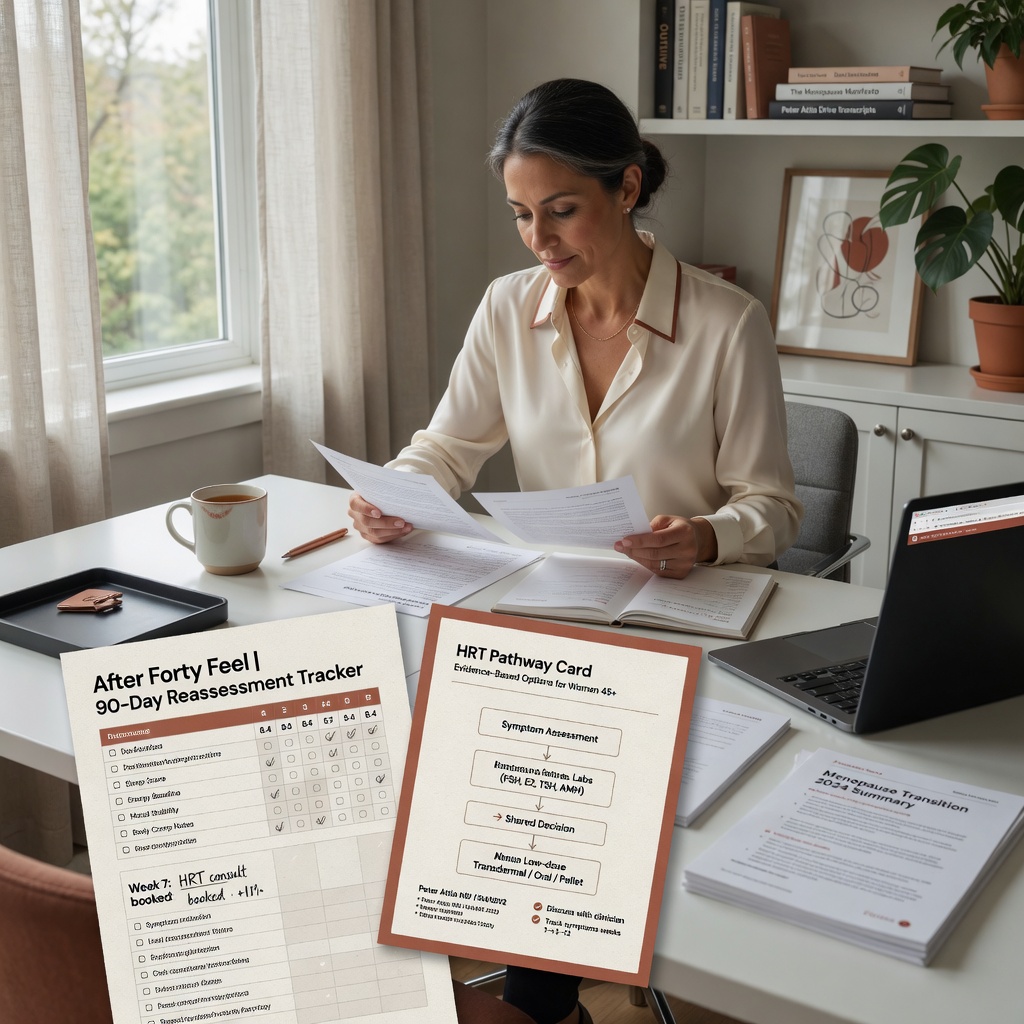

The Sunday letter
Free. Research-led. One thoughtful letter a week.
Recommended next step
Get personalized clarity or start a pathway
Take the 90-second Hormone Age quiz for your gap analysis, or walk a full decision pathway for HRT, metabolism, TRT, or cognition. Start the quiz · Explore pathways